
Pickleball Serving Rules
If you come from a tennis background, prepare to rewire your muscle memory. There are no 115 mph overhead serves in pickleball, no leaping off the ground, and no second serves when your first ball clips the tape.
In pickleball, the serve is designed to start the rally on fair, equal footing. It is an underhand shot that puts the ball in play without giving the server an overwhelming advantage.
USA Pickleball gives you two completely legal ways to serve: the traditional volley serve (hit out of the air) and the drop serve (hit off a bounce).
Where You Stand and Where the Ball Goes
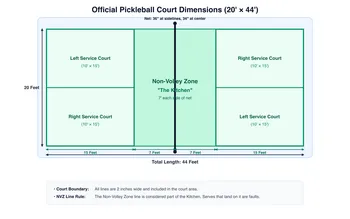
Regardless of which serve technique you prefer, the court rules remain identical:
- Keep both feet behind the baseline. When your paddle strikes the ball, both feet must be behind the line and between the imaginary extensions of the sideline and centerline. Stepping on or over the painted baseline before contact is an immediate foot fault.
- Hit diagonally crosscourt. Your serve must cross the net and land within the diagonal service box on the opposite side.
- Clear the kitchen line completely. All painted boundary lines on a pickleball court are considered in, with one major exception. On the serve, the seven-foot kitchen line is considered out. If your serve clips any part of the kitchen line, you commit a fault.
- You only get one chance. There is no second serve in pickleball. If your serve sails long or catches the net, your turn is done, and you hand the serve over to your partner or the other team.
The Traditional Volley Serve
When you hit a volley serve, you toss or release the ball from your hand and strike it out of the air before it touches the ground.
To keep things fair, the official rules require three mechanical checkpoints at the moment your paddle touches the ball:
- Your arm must swing in an upward arc. You cannot chop down or slice sideways at the ball from shoulder height.
- Contact must happen below your navel. Your paddle face has to connect with the ball below your waistline.
- Your paddle head must stay below your wrist. The top edge of your paddle cannot be pointing up higher than the bend of your wrist on contact.
The Drop Serve (The Stress-Free Option)
If remembering wrist angles and navel heights sounds like a headache, the drop serve is your new best friend. USA Pickleball introduced the drop serve to end heated sideline arguments over whether someone’s serve was an inch too high.
Here is how it works:
- Hold the ball out at a comfortable height and simply let it drop. You cannot throw it down forcefully or spin it with your fingers.
- Let the ball bounce once on the court surface.
- Strike the ball off the bounce.
The biggest perk of the drop serve is that the three volley serve restrictions vanish. Because the ball already bounced, you do not need to worry about upward arcs, navel height, or wrist positioning. You can swing through the ball however feels natural.
The Two-Bounce Rule in Action
Once your serve lands cleanly in the diagonal service box, the famous two-bounce rule takes over:
- Bounce number one belongs to the receiver. The receiving player must let the serve bounce once before returning it.
- Bounce number two belongs to the server. The serving team must let that return bounce once before hitting their next shot (the third shot).
Only after those two bounces have occurred can either team start hitting volleys out of the air.
Why this rule shapes the entire game
The two-bounce rule is why pickleball is such a brilliant tactical sport. Because the serving team has to stay back and wait for the second bounce, the receiving team has time to comfortably advance to the kitchen line.
This flips the court advantage to the receiving team right away. To reach the net safely, the serving team has to hit a soft, patient shot into the opponent’s kitchen (a third shot drop) or hit a well-placed drive.
Common Serving Mistakes to Watch For
- Stepping on or over the baseline before your paddle makes contact with the ball.
- Letting your serve nick the white tape of the kitchen line.
- Missing the diagonal service box wide or deep past the baseline.
- Forgetting the two-bounce rule and smacking the opponent’s return out of the air on your third shot.
- Hitting the serve before calling out the full score loud enough for your opponents to hear.