
How to Play Pickleball
If you feel like everyone in your neighborhood suddenly started carrying strange plastic paddles on Saturday mornings, you are not imagining things. Pickleball took off because it hits a sweet spot that few sports manage. It is fast, social, easy on the joints, and you can play an actual game on your very first day without spending three months taking lessons.
The basic premise is simple. You hit a plastic wiffle-style ball over a low net and try to keep it inside the white lines until the other team makes a mistake. Most people play doubles (two against two), which means less sprinting and plenty of good-natured banter between points.
Before you wander onto a public court and wonder why people are shouting random three-digit numbers, here is the quick rundown you actually need.
How a Game Actually Flows
Games are usually played to 11 points, and you have to win by 2. The biggest twist for newcomers is that you can only score a point when your side is the one serving. If the other team wins a rally, they do not get a point. They just earn the right to serve.
Here is how each point unfolds from start to finish:
- The underhand serve. The server stands behind the baseline and hits the ball diagonally across the net. No overhead tennis serves here. You hit underhand, aiming past the opponent’s kitchen line into their service square.
- The two bounces before anyone smacks a volley. This rule trips up almost everyone with a tennis background. The receiving team must let the serve bounce once. Then the serving team must let the return bounce once. Once those first two bounces happen, either team can hit the ball in the air or off the bounce.
- The rally. Now the point is wide open. Both teams try to work their way up to the kitchen line, tapping soft shots back and forth until someone gets impatient or hits one too high.
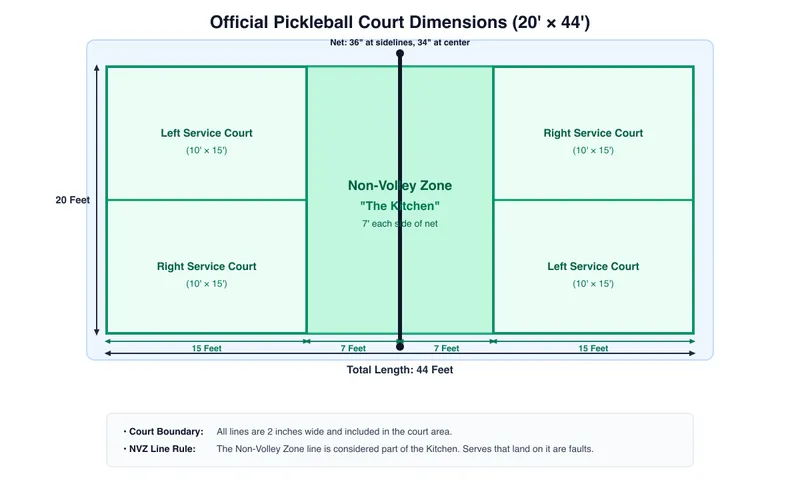
- Staying out of the kitchen. You cannot hit a ball out of the air while standing inside the seven-foot zone right next to the net. If you step in there, the ball has to bounce first.
- The fault. If someone hits the ball into the net, sends it past the baseline, lets it bounce twice, or steps into the kitchen during a volley, the rally ends in a fault.
The Basic Gear You Need
One of the best things about pickleball is that you do not need a giant bag of specialized equipment or an expensive country club membership.
- A solid paddle. You do not need a $250 carbon fiber paddle on day one. A mid-weight paddle between 7.7 and 8.2 ounces gives you plenty of control while you figure out your swing. A beginner paddle under $100, or a 2-player starter set, is plenty.
- A couple of balls. Pickleballs look like heavy-duty Wiffle balls. Outdoor balls have 40 small drilled holes to handle the wind, while indoor gym balls have 26 larger holes for a softer bounce on wooden floors.
- Real court shoes. Please do not wear running shoes. Running shoes are designed for forward momentum, and their thick soles can easily catch during side-to-side shuffles. A good pair of tennis or court shoes will protect your ankles and your knees.
- A court and a net. Courts are 20 feet wide by 44 feet long, which happens to be the exact size of a badminton court. The net hangs 34 inches high in the center, two inches lower than a tennis net. A portable net in the driveway works too.
What to Read Next
Once you have the basics down, check out these guides to get comfortable with the details:
- Basic Pickleball Rules covering the five fundamentals every beginner should know.
- The Kitchen Rule so you never commit an accidental foot fault at the net.
- Serving Rules to make sure your underhand stroke is legal and consistent.
- How Doubles Scoring Works to finally understand what “4-2-1” means.
- Court Dimensions and Layout if you want to understand the lines and boundaries.