
Pickleball Court Dimensions
Chalking temporary lines on your driveway, setting up tape in a community gym, or simply wondering how much territory you cover during Saturday open play all come down to one compact footprint.
One of the best things about pickleball is its efficiency. The court uses the exact same footprint for both singles and doubles play, and you can comfortably fit four full pickleball courts inside a single regulation tennis court.
Here is the straightforward breakdown of official court dimensions, net heights, and safety clearances.
The Key Numbers at a Glance
If you just need the quick measurements to lay down court tape, keep these numbers handy:
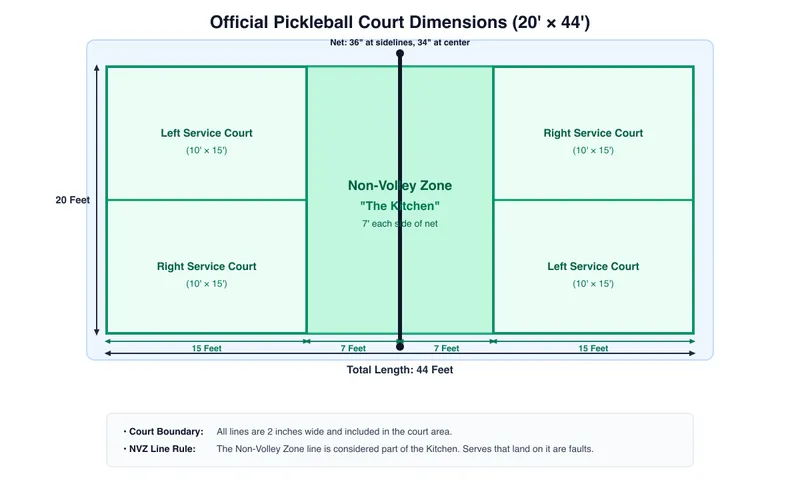
- Court boundaries. A regulation court measures exactly 20 feet wide by 44 feet long. That is identical to a standard doubles badminton court.
- Recommended playing area. While the court lines are 20 by 44 feet, you need buffer space around the edges. A minimum footprint of 30 feet wide by 60 feet long ensures players can chase down lobs without crashing into fences, benches, or parked lawn chairs.
- The kitchen depth. The Non-Volley Zone extends 7 feet out from the net on both sides, spanning the entire 20-foot width of the court.
- Service boxes. Each service box measures 10 feet wide by 15 feet long, giving you a generous landing target for serves.
- Line thickness. All official court lines are 2 inches wide, and the width of the line is included in the court measurements.
Net Specifications (How It Differs from Tennis)
A pickleball net looks a lot like a tennis net, but it sits slightly lower:
- Height at the sidelines. The net stands 36 inches tall at the outside posts.
- Height at the center. The net dips to 34 inches in the dead center of the court. A center strap keeps the net pulled down to this exact height.
- Net length. The net spans at least 21 feet 9 inches from post to post, which allows it to extend about a foot beyond the sidelines on either side.
- Post placement. Posts should sit 12 inches outside the sideline boundary to give players room to hit around-the-post shots.
Breaking Down the Court Zones
When you look across the net, the court divides cleanly into four distinct zones:
The Non-Volley Zone (The Kitchen)
The seven-foot area extending from the net on both sides. Remember that the two-inch white line at the back of the kitchen counts as part of the kitchen itself.
The Right Service Court (The Even Box)
Standing at your baseline facing the net, this is the 10 by 15 foot box on your right. Servers hit from this side whenever their team score is an even number (0, 2, 4, 6, 8, 10).
The Left Service Court (The Odd Box)
The matching 10 by 15 foot box on your left. Servers hit from here whenever their team score is an odd number (1, 3, 5, 7, 9).
The Centerline
The line running straight down the middle of the court from the kitchen line back to the baseline, neatly splitting the service boxes into equal 10-foot halves.