
Basic Pickleball Rules
When you first hear pickleball players shouting across the court about dinks, kitchens, and side-outs, it sounds like an entirely different language. The great news is that beneath the quirky terminology (which you can look up anytime in our pickleball glossary), the game is built around just five core rules.
Once you wrap your head around these five fundamentals, you can walk onto any public court with confidence and fit right in with the regular weekend crowd.
1. Keep the Ball Inbounds
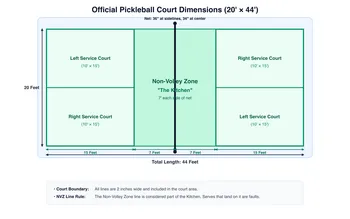
Just like tennis or ping-pong, you have to hit the ball over the net and keep it inside the boundary lines on the opposite side. You can review the exact lines in our court dimensions guide:
- Any ball that touches any part of the sideline or baseline is good. In pickleball, the line is your friend.
- The one big exception is the serve. On a serve, the ball must completely clear the seven-foot kitchen line. If the serve touches the kitchen line, it counts as an immediate fault.
- If the ball hits a fence, a net post, or your partner before it bounces, the rally is over and the point goes to the other team.
2. Respect the Two-Bounce Rule
This is the rule that separates pickleball from tennis, and it is the single most important rule to remember during your first week:
- The receiving team must let the serve bounce once before hitting it back.
- The serving team must let the return bounce once before hitting it.
That means two bounces total, one on each side, before anyone is allowed to hit a ball out of the air.
Once those first two bounces happen, all bets are off. Both teams can either hit the ball on the bounce (a groundstroke) or strike it out of the air (a volley).
3. Keep the Serve Underhand
You will not see anyone hitting 120 mph overhead serves in pickleball. The serve is designed to start the rally fairly, not to end it with an unreturnable missile.
When you hit a traditional volley serve out of the air:
- Your arm must move in an upward arc when you strike the ball.
- You must make contact below your navel.
- The top edge of your paddle head must stay below your wrist on impact.
If all those angles sound like too much geometry to worry about before your morning coffee, use the drop serve. You simply drop the ball from any comfortable height, let it bounce once on the court, and hit it off the bounce. When you use a drop serve, the waist and wrist height restrictions disappear entirely.
4. Stay Out of the Kitchen on Volleys
The seven-foot area extending out from both sides of the net is officially called the Non-Volley Zone, but everyone calls it the kitchen.
- You cannot hit the ball out of the air while standing in the kitchen or stepping on the kitchen line.
- If your forward momentum causes you, your paddle, or your sunglasses to land on the line after hitting a volley, you commit a fault.
- You are completely allowed to stand inside the kitchen whenever you want. You just have to let the ball bounce first before hitting it.
Check out our Kitchen Rules Guide for a deeper look at how to avoid foot faults at the net.
5. You Can Only Score on Your Serve
In traditional pickleball, only the team currently serving can earn points:
- If the serving team wins the rally, they get one point.
- If the receiving team wins the rally, they do not get a point. Instead, they earn a side-out, which transfers the serve over to them so they can start scoring.
- Standard games are played to 11 points, and you must win by at least 2 points (for example, 11-9 or 12-10).
Calling the Score Before You Serve
Before you hit each serve, you have to announce the score loudly enough for the other side to hear. In doubles, you call out three numbers in order:
- Your team’s score first.
- The opponent’s score second.
- Your server number (either 1 or 2).
If you are the second server on your team and the score is 4 to 2 in your favor, you call out “4-2-2” before serving.
Server rotation and the 0-0-2 start make more sense once you read Pickleball Scoring and Rotations.