
Doubles Pickleball Rules
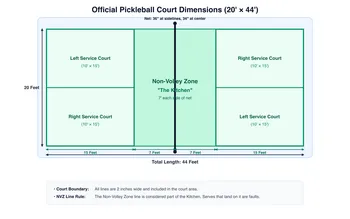
Doubles is the heartbeat of pickleball. Probably ninety percent of the games you will see at your local park are doubles, and for good reason. With four players sharing a 20 by 44 foot court, the game is less about running wind sprints and more about quick hands, smart positioning, and having a blast with your partner.
While the core rules of pickleball stay the same whether you play solo or as a duo, doubles brings its own rhythm. Here is how starting alignments, partner rotations, and court strategy come together.
Where Everyone Stands on the Serve
When a rally begins in doubles, each of the four players has a specific starting spot on the court:
- The server stands behind the baseline on the side dictated by the team score (right side if the team score is even, left side if odd).
- The server’s partner hangs back near the baseline too. Because of the two-bounce rule, the serving team cannot hit the return out of the air, so staying back prevents you from getting caught flat-footed in no-man’s-land.
- The receiver stands behind the baseline diagonally across from the server, ready to let the serve bounce once before hitting it back.
- The receiver’s partner gets the best seat in the house. They are already standing right up at the kitchen line. Because they do not have to hit the return, they are legally allowed to claim the net immediately.
The Race to the Kitchen Line
In doubles pickleball, the team that controls the kitchen line controls the point. Standing seven feet from the net gives you superior angles, allows you to hit downward at your opponents’ feet, and cuts down their reaction time.
The receiving team starts with a huge advantage. The receiver’s partner is already parked at the kitchen line, and as soon as the receiver returns the serve, they can sprint forward to join their partner. Just like that, the receiving team has locked down the net.
The serving team has to work much harder. Because they must let the return bounce, both serving partners are pinned back at the baseline. To advance safely without getting their heads taken off by a hard volley, they usually rely on a third shot drop, a soft, arching shot that lands gently in the opponents’ kitchen. That soft shot buys enough time for both partners to walk up and set their feet at the line.
The Patience Game (Dinking)
Once all four players are stationed at their respective kitchen lines, the game transforms into a cat-and-mouse dinking exchange.
You and your partner trade soft, controlled taps back and forth across the net. The goal is simple: keep the ball low so the other team cannot smash it downward, and wait for someone on the other side to get impatient, hit the ball too high, or send one into the net.
The team that stays patient and avoids silly unforced errors almost always wins the dink rally.
Stacking: Playing Your Preferred Side
As you play more doubles, you will notice some teams using a strategy called stacking.
Normally, players switch sides whenever their team scores a point. But if you have a great forehand on the left, or you are paired with a left-handed player, you might want to keep your best shots in the middle of the court on every single point.
Stacking allows partners to line up on the same half of the court before the serve or return. As soon as the ball is struck, both players slide over to their preferred positions. As long as the correct player hits the serve or return according to the score, shifting positions during the rally is 100 percent legal.
Partnership Tips to Keep Your Games Fun
- Call the middle ball loudly. The space between partners causes more lost points than any other shot. Decide in advance who takes middle shots (usually whoever has their forehand facing the center), and yell “Mine!” or “Yours!” early.
- Move together like you are tied with a rope. If your partner gets pulled wide to the right sideline, slide over to the right with them to cover the middle gap. Proper court positioning ensures you do not leave a giant runway wide open right down the center of the court.
- Be an encouraging teammate. Everyone misses easy dinks or puts a ball into the net. Give your partner a quick paddle tap, shake off the error, and get ready for the next point.